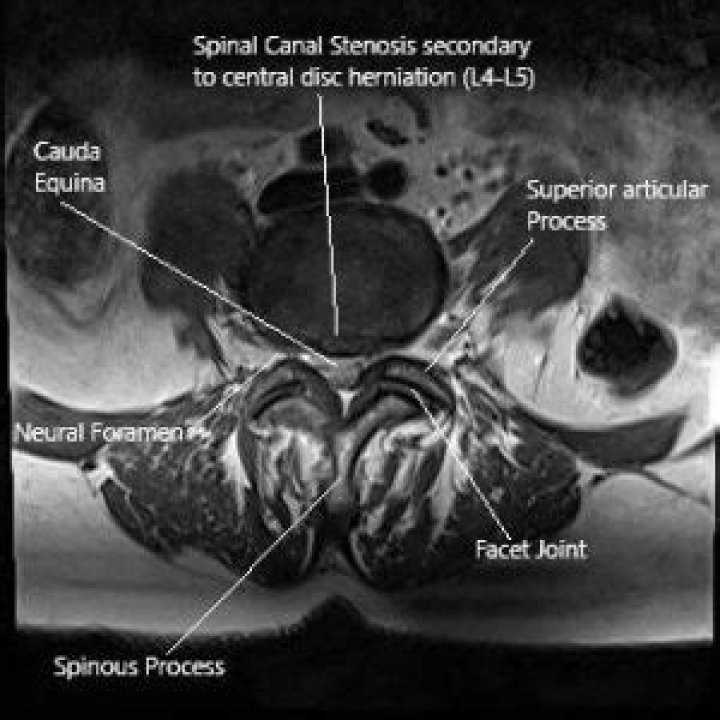
Can an MRI scan detect sciatica?
Today, when a patient experiences painful and persistent sciatica, physicians typically perform a physical exam and ultimately rely on MRI scans to show the extent to which a disc or discs may be damaged.How do they diagnose you with sciatica?
Magnetic resonance imaging (MRI) or computed tomography (CT) scans to see detailed images of bone and soft tissues of the back. An MRI can show pressure on a nerve, disk herniation and any arthritic condition that might be pressing on a nerve. MRIs are usually ordered to confirm the diagnosis of sciatica.What is the best scan for sciatica?
An MRI scan is generally considered to be the single best imaging study of the spine to help plan treatment for back pain. Physicians usually have a good idea of what they are looking for on the MRI scan before one is performed.Do pinched nerves show up on MRI?
MRI scans which show soft tissues, such as nerves and discs, are generally preferred over CT scans which show bony elements. Advanced imaging can show exactly which nerve or nerves are being pinched and what is causing the nerve to be pinched.My MRI and X-ray were normal, so what is causing my pain? The answer is often seen in motion imaging
Does an MRI show nerve inflammation?
An MRI may be able help identify structural lesions that may be pressing against the nerve so the problem can be corrected before permanent nerve damage occurs. Nerve damage can usually be diagnosed based on a neurological examination and can be correlated by MRI scan findings.Can an MRI show inflammation?
MRI allows to assess the soft tissue and bone marrow involvement in case of inflammation and/or infection. MRI is capable of detecting more inflammatory lesions and erosions than US, X-ray, or CT. Standard scintigraphy plays a crucial role, and data from positron emission tomography (PET) are also promising.What is the fastest way to cure sciatica?
Alternating heat and ice therapy can provide immediate relief of sciatic nerve pain. Ice can help reduce inflammation, while heat encourages blood flow to the painful area (which speeds healing). Heat and ice may also help ease painful muscle spasms that often accompany sciatica.How do you release a sciatic nerve?
Gently pull your right leg across your body toward your left shoulder. Hold it there for 30 seconds. Remember to pull your knee only as far as it will comfortably go. You should feel a relieving stretch in your muscle, not pain.Can sciatic nerve damage permanent?
Although most people recover fully from sciatica, often without treatment, sciatica can potentially cause permanent nerve damage. Seek immediate medical attention if you have: Loss of feeling in the affected leg. Weakness in the affected leg.Can barely walk with sciatica?
Inability to walk: All of the symptoms of sciatica can come together and make it difficult for you to walk. Putting pressure on your leg to stand can lead to extreme pain and the weakness of the leg could even lead to you falling.What happens if sciatica is left untreated?
If left untreated, sciatica can cause permanent nerve damage that worsens back and leg pain. Over time, the pain may extend to other parts of the body. In some cases, patients stop responding to pain medication, thereby developing chronic pain that cannot be remedied.Is my pain sciatica or something else?
Sciatica pain is often experienced as a shooting, searing pain that radiates down the back of the leg. Sometimes, numbness, tingling, or burning is felt along the nerve. Some people describe the nerve pain as electric-like. Conversely, sciatica symptoms may be experienced as more of a constant, dull pain.Does an MRI show nerve damage in back?
Does an MRI scan show nerve damage? A neurological examination can diagnose nerve damage, but an MRI scan can pinpoint it. It's crucial to get tested if symptoms worsen to avoid any permanent nerve damage.What will an MRI show for lower back pain?
A lumbar spine MRI can detect a variety of conditions in the lower back, including problems with the bones (vertebrae), soft tissues (such as the spinal cord), nerves, and disks.What causes sciatica buttock pain?
When a person injures or overworks the piriformis muscle, it can press on the sciatic nerve. The sciatic nerve runs down from the lower spine through to the buttocks and the back of the thigh. The pressure of the muscle on the sciatic nerve causes the pain known as sciatica.Is bed rest good for sciatica?
Discussion. We found no evidence that bed rest is an effective treatment for patients with sciatica.Is sciatica temporary or permanent?
The quick answer is that typically, Sciatica is a temporary issue. Most people are better in 4 to 8 weeks. In rare cases, it can lead to permanent disability, but there are usually other factors such as severe nerve injury, other health complications, obesity, and a lack of conditioning.What are the stages of sciatica?
Types of Sciatica
- Acute sciatica. Acute sciatica is a recent onset, 4 to 8-week duration of sciatic nerve pain. ...
- Chronic sciatica. Chronic sciatica is persistent sciatic nerve pain that lasts for more than 8 weeks and usually does not subside with self-management. ...
- Alternating sciatica. ...
- Bilateral sciatica.