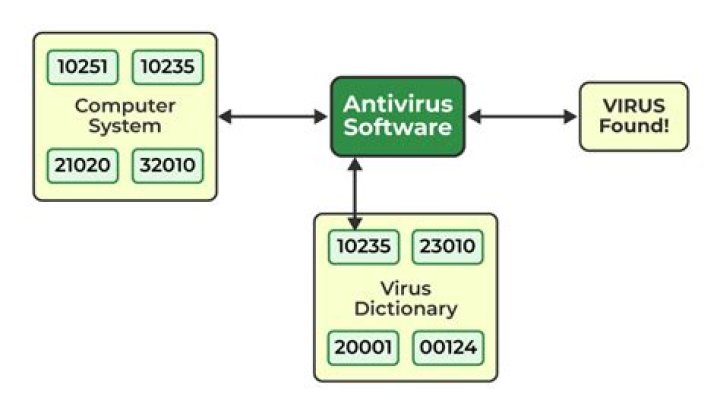
What is the purpose of virus signature?
A virus signature (also known as a virus definition) is a file or multiple files that are downloaded by a security program to identify a computer virus. The files enable detection of malware by the antivirus (and other antimalware) software in conventional file scanning and breach detection systems.How do I find my antivirus signature?
1. Click Security Services > Anti-Virus > General Settings. 2. In the Update Virus Database area, you can view the status of the Anti-Virus signature file.How do antivirus signatures work?
Antivirus products use signature-based detection in conjunction with a database. When scanning a computer, they'll search for footprints matching those of known malware. These malware footprints are stored in a database. Antivirus products essentially search for the footprints of known malware.Is updating of antivirus program necessary?
It is important to constantly update the antivirus software on a computer because computers are regularly threatened by new viruses. The anti-virus updates contain the latest files needed to combat new viruses and protect your computer.How Does Antivirus Software Work And How To Evade It
What happens if you don't update your antivirus?
Well, the answer is pretty simple. If you will delay updating your antivirus software program, you might not be as protected from cyber security risks as you might think. Even worse, your device could be at risk of the latest threats that your security product is not yet aware of.What happens if I don't renew my antivirus?
What happens if I don't renew my antivirus? If you ignore the warnings, or never saw them, then the software will probably stop getting the latest virus updates and your computer could be vulnerable against any new viruses and other malware.What is the purpose of signature files?
A signature file allows fast search for text data. It is typically a very compact data structure that aims at minimizing disk access at query time.What is signature malware?
August 12, 2021. by SentinelOne. Many security products rely on file signatures in order to detect malware and other malicious files. The technique involves reading or scanning a file and testing to see if the file matches a set of predetermined attributes. These attributes are known as the malware's 'signature'.Can antivirus detect unknown malware?
Antivirus is capable of detecting a great deal more than simple viruses and is not reliant on simple detection of static strings. Scanners can detect known malware with a very high degree of accuracy and can cope with a surprisingly high percentage of unknown malware, using heuristic analysis.How do I update my Windows Defender signature?
Update Windows Security signatures
- Select Start > Settings > Update & Security > Windows Security > Virus & threat protection.
- Select Check for updates (or Virus & threat protection updates in previous versions of Windows 10).
- Under Security Intelligence, select Check for updates.
Is Microsoft Defender signature-based?
Endpoint SecurityWindows Defender is a signature-based antimalware system, and these signatures provide the definitions that Windows Defender uses to identify malware on a Windows system. These signatures provide information about current spyware and other forms of malware.
What are some symptoms of computer virus infection?
Symptoms of Malware
- Your computer or web browser has dramatically slowed down over a period of a few days/a week.
- Frequent freezing or crashing.
- Modified or deleted files.
- New programs or desktop icons that you do not recall installing/creating.
- Programs running without your consent.
- Programs closing without your consent.
What is a disadvantage of signature-based malware detection?
One of the major drawbacks of the signature-based method for malware detection is that it cannot detect zero-day attacks, that is an attack for which there is no corresponding signature stored in the repository.How often should the signature files be updated?
No human intervention is required at any time. We recommend that a 12h interval be used for automatic signature updates to check the server twice a day however you can elect for a longer or shorter update check interval depending on your personal preferences.What can malware do to avoid file based signature-based detection?
Another major problem with signature-based malware detection is that today's advanced malware can alter its signature to avoid detection. Signatures are created by examining the internal components of an object. Malware authors simply modify these components while preserving the object's functionality and behavior.Is McAfee signature-based?
McAfee Next Gen AV Engine combines our award-winning signature based detection with a new and advanced technology called Real Protect, an automated, cloud-based, behavioral analytics and machine learning solution which unmasks, classifies, and blocks zero-day and polymorphic malware in near real-time.What is a signature in security?
In computer security terminology, a signature is a typical footprint or pattern associated with a malicious attack on a computer network or system. This pattern can be a series of bytes in the file (byte sequence) in network traffic.What are signatures as they relate to security threat?
What are signatures as they relate to security threats?
- a unique encryption code used by a known attacker.
- one or more code patterns within a specific type of malware.
- the beginning or end of a malware segment that has a specific cyclic redundancy check number.