division of cells
In eukaryotes, there are two distinct types of cell division; a vegetative division, whereby each daughter cell is genetically identical to the parent cell (mitosis), and a reproductive cell division, whereby the number of chromosomes in the daughter cells is reduced by half to produce haploid gametes (meiosis).
› wiki › Cell_division
homologous chromosomes
A bivalent is one pair of chromosomes (sister chromatids) in a tetrad. A tetrad is the association of a pair of homologous chromosomes (4 sister chromatids) physically held together by at least one DNA crossover.
› wiki › Bivalent_(genetics)
What is the importance of anaphase 1 and anaphase 2 quizlet?
The cell undergoing anaphase II is genetically different from what it contained while undergoing anaphase I. B. Anaphase I occurs in a haploid cell while anaphase II occurs in a diploid cell. It could be said that males are able to provide gametes with more genetic diversity than females for reproduction.Why is anaphase 2 important in meiosis?
Meiosis is a reproductive cell division since it gives rise to gametes. The resulting cells following meiosis contain half of the number of the chromosomes in the parent cell.What is the importance of anaphase 1?
Anaphase IIThis allows the separation of the sister chromatids which are then singly referred to as sister chromosomes. They move towards the opposite poles of the cells.
What happens in anaphase 1 and 2 in meiosis?
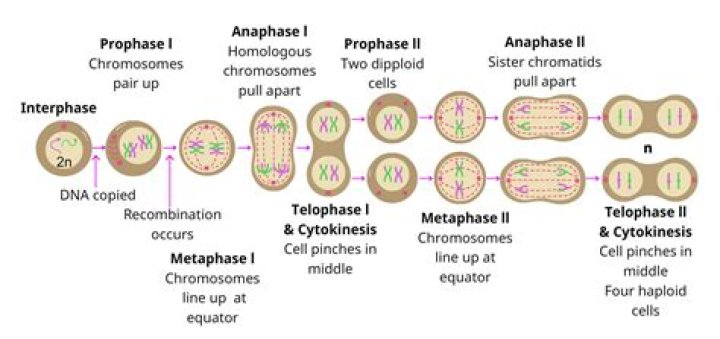
With meiosis, two rounds of anaphase occur. During anaphase 1, homologous chromosomes separate and move to opposite ends of the cell. With anaphase 2, the sister chromatids separate in much the same manner as mitotic anaphase.What happens during anaphase 1 and anaphase 2?
What is the main difference between anaphase 1 and anaphase 2?
Anaphase 1 and anaphase 2 are two phases in the meiotic division of cells which produces gametes during the sexual reproduction. The main difference between anaphase 1 and 2 is that homologous chromosomes are separated during anaphase 1 whereas sister chromatids are separated during anaphase 2.How can anaphase 1 and anaphase 2 be distinguished from each other?
Note: Anaphase II can also be distinguished from the anaphase I of meiotic division on the basis of chromatids: In anaphase I, each chromosome has two distinct chromatids, but in anaphase II, each chromosome is represented by one chromatid only. The separated chromosomes appear decondensed and form nuclei (Fig.What is the most important phase of meiosis?
Prophase I is the longest and arguably most important segment of meiosis, because recombination occurs during this interval.What is the significance of anaphase in this process?
What is the significance of anaphase in this process? 1) Anaphase usually ensures that each daughter cell has the same number of chromosomes as the parent cell. 2) Anaphase usually ensures that each daughter cell has twice as many chromosomes as the parent cell.What is the importance of various prophase I stages of meiosis I?
Prophase I highlights the exchange of DNA between homologous chromosomes via a process called homologous recombination and the crossover at chiasma(ta) between non-sister chromatids. Thus, this stage is important to increase genetic variation.Why is meiosis II needed?
Cell Cycle and Cell Division. Why Meiosis II is necessary when cell is divided in Meiosis I ? The two chromosomes are not seperated during Meiosis I. The cells are diploid, therefore in order to distribute the chromosomes eqully among the daughter cells so that they contain half the chromosome , Meiosis II is necessary ...What happens in meiosis during anaphase 1?
In anaphase I, the homologues are pulled apart and move apart to opposite ends of the cell. The sister chromatids of each chromosome, however, remain attached to one another and don't come apart.What happens at anaphase 2 of meiosis?
Meiosis IIAnaphase II: The chromatids split at the centromere and migrate along the spindle fibers to opposite poles. Telophase II: The cells pinch in the center and divide again. The final outcome is four cells, each with half of the genetic material found in the original.